Time-Varying Photonics: Past, Present and Future
admin 2026-09-21 17:14:14 116
报告题目:Time-Varying Photonics: Past, Present and Future
报告时间:2026-09-22 11:00 (星期二)
报告地点:北洋园校区 49 教 410 室
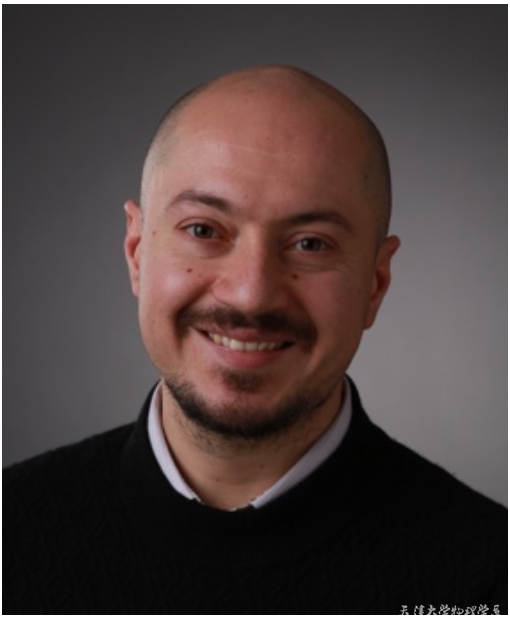
报告人:Marcello Ferrera (Heriot-Watt University)
Abstract:
Time-varying photonics offers a route to controlling light through temporal, rather than solely spatial, variations of the optical environment. Low-index transparent conducting oxides have emerged as a particularly powerful platform for accessing this regime. When excited near their crossover wavelength, these materials’ refractive index can undergo exceptionally large changes on femtosecond timescales [1]. The resulting temporal gradients allow propagating photons to exchange both energy and momentum with the evolving medium, introducing new degrees of freedom for manipulating optical fields beyond the capabilities of static photonic structures [2]. Understanding these strongly driven systems also requires moving beyond conventional material descriptions, as their ultrafast response originates from the coupled dynamics of the electron plasma and the solid-state lattice under broadband excitation outside the perturbative approach [3]. This presentation will review the development of this research from the emergence of low-index ultrafast photonics to current realizations of time-varying optical systems, and will discuss future opportunities enabled by this approach. Recent advances include ultrafast pulse characterization, quantum-dot emission enhancement, all-optical polarization control, spatio-temporal photonics, and machine-learning-assisted ultrafast photonics [4–7], pointing towards applications in nonlinear and integrated photonics, ultrafast information processing, and quantum science.
[1] W. Jaffray, et al., Advances in Optics and Photonics, vol. 14, pp. 148–208, 2022.
[2] W. Jaffray, et al., Nature Photonics, vol. 19, pp. 558–566, 2025.
[3] W. Jaffray, et al., Advanced Optical Materials, vol. 12, Art. no. 2303199, 2024.
[4] W. Jaffray, et al., Nature Communications, vol. 13, Art. no. 3536, 2022.
[5] S. Stengel, et al., APL Quantum, vol. 3, p. 016106, 2026.
[6] W. Jaffray, et al., Nature Photonics, vol. 20, pp. 628–636, 2026.
[7] W. Jaffray, et al., Machine Learning: Science and Technology, vol. 5, p. 045074, 2024.
Biography: Marcello Ferrera is Professor of Nanophotonics at Heriot-Watt University, UK, within the Institute of Photonics and Quantum Sciences, where he serves as Director of the MSc program in Quantum Technologies. He previously served as Deputy Director of the MSc program in Photonics and Optoelectronic Devices, jointly delivered with the University of St Andrews. His research focuses on time-varying photonics and ultrafast light–matter interactions in lowindex and epsilon-near-zero materials, with applications spanning optical signal processing, quantum optics, integrated photonics, alloptical devices, and photonic computing. He played an instrumental role in initiating and establishing the use of Hydex technology, originally developed by Infinera Corporation, as a platform for nonlinear integrated photonics and quantum applications. More recently, his research has contributed to the emergence of low-index time-varying materials as a platform for extreme manipulation of light on sub-wavelength and ultrafast timescales. His work has been published in leading international journals including Nature Photonics, Nature Communications, Advanced Materials, Advances in Optics and Photonics, Light: Science & Applications, Advanced Photonics, Physical Review Letters, Optica, and Nano Letters, and has attracted international media coverage, including features and interviews by the BBC and The Herald, as well as expert commentary in New Scientist. His early work on integrated photonic computing was also recognised by the Encyclopaedia Britannica Book of the Year among the most notable scientific achievements of the year globally.